The Mecca pact: what’s going on between Turkey, Saudi Arabia and Pakistan
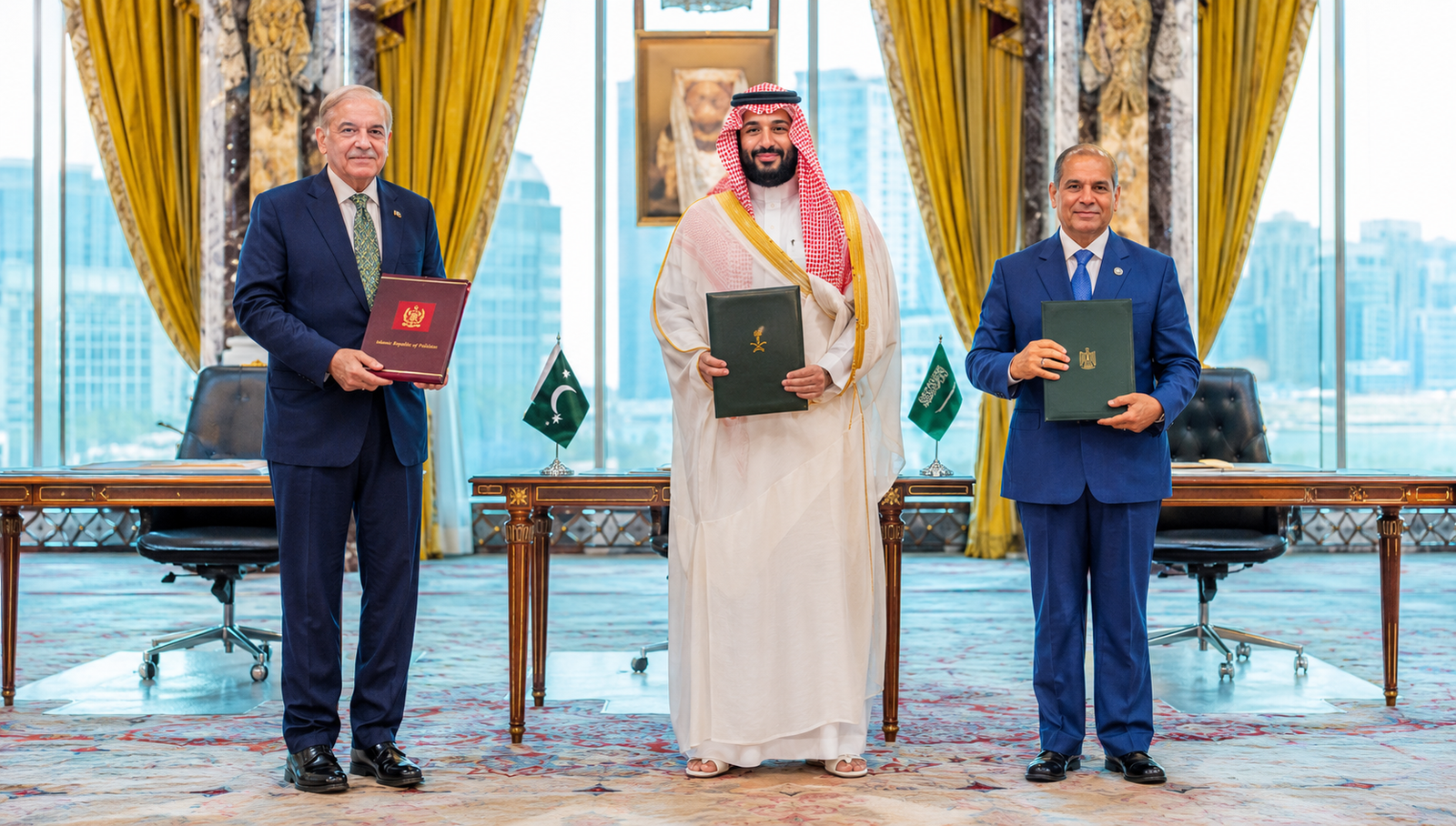
On August 7, 2026, at Al-Safa Palace in Mecca, Mohammed bin Salman, Recep Tayyip Erdoğan and Shehbaz Sharif signed a trilateral defence pact, confirmed by the Saudi Press Agency, stating that any armed attack against one of the three states will be treated as an attack against all three.
That’s a mutual-defense clause — NATO’s Article 5, roughly, for three countries that together hold Islam’s two holiest cities, one of NATO’s largest militaries, and the only nuclear-armed state in the Muslim world.
Tap any country to see how it fits into the Mecca defence pact
Select a country above to see where it stands.
Three deals, not one
Layer 1 is the Saudi-Pakistan Strategic Mutual Defence Agreement, signed back on September 17, 2025 — months before Turkey entered the picture. Same core idea: an attack on one is an attack on both. This is the deal Pakistan first acted on in April 2026, sending roughly 13,000 troops and a squadron of jets to a Saudi air base, according to Saudi Arabia’s own defence ministry (Pakistan itself never confirmed the figure).
Layer 2 is the new Mecca Joint Defence Agreement, which folds Turkey into that same promise. Turkish FM Hakan Fidan says the three sides had quietly been negotiating for two years and eight months — since shortly after October 7, 2023. It took the 2026 Iran war, and Israel’s September 2025 strike on Doha, to actually push it over the line.
Layer 3 is years of arms deals underneath both agreements — Turkish Bayraktar Akıncı drones sold to Saudi Arabia in a contract Ankara’s own defence chief called worth “more than $3 billion,” Turkish-built Babur-class corvettes for Pakistan’s navy, and ongoing talk of Pakistan joining Turkey’s KAAN stealth-fighter program.
Notably: none of the three governments has published the actual legal text of either agreement. What obligations really kick in, and at what threshold, still isn’t public.
But governments aren’t that simple
Saudi Arabia just signed a 30-year civilian nuclear cooperation deal with Washington in July 2026. Days before the Mecca pact, the US and Saudi Arabia carried out joint strikes against Iran-backed militias in Iraq. When Saudi Arabia built its own separate coalition in July to protect Red Sea shipping from Houthi attacks, it invited the United States to join — Washington sent officials to the founding meeting in Riyadh but, as of this writing, has not formally joined.
Turkey, meanwhile, is a full NATO member. It isn’t choosing Islam over the alliance — it’s hedging inside both at once.
Pakistan’s role is the most interesting, though. While signing a mutual-defense pact with Riyadh, Islamabad was simultaneously the country that brought the US and Iran to the negotiating table after their 2026 war — Pakistan’s army chief, Field Marshal Asim Munir, was called “my favorite field marshal” by Donald Trump for it, and PM Sharif personally signed the US-Iran ceasefire framework in Geneva in June 2026. So the same government is a Saudi military ally, a mediator Washington trusts, and a neighbor still trying not to torch its relationship with Iran — all at once.
Israel is a bit complicated
Saudi Arabia’s stated position is no diplomatic ties without a credible path to Palestinian statehood, and Saudi officials have said normalization is unlikely under Israel’s current government. However, Saudi Arabia does have a quiet defence coordination with Israel, reported during the Gaza war, alongside plenty of public Saudi criticism of Israeli actions.
So the Mecca pact isn’t a peace deal, and it isn’t a declaration of war either. Former Israeli PM Naftali Bennett has spent months warning about an emerging “Sunni axis” involving nuclear-armed Pakistan; current PM Netanyahu has echoed similar language ahead of Israel’s October elections. But officially, Israel hasn’t responded to the pact at all.
Nuclear power
This might be the part that matters most — and the part everyone is deliberately vague about. Pakistan’s own defence minister has given contradicting answers months apart: once telling Pakistani TV that Pakistan’s “capabilities” would be made available to Saudi Arabia “according to this agreement,” then later telling Reuters that nuclear weapons were “not on the radar.” A Saudi analyst close to the royal court told AFP flatly that nuclear capability is “integral to this deal.” A senior Saudi official has separately said the pact isn’t “linked to any nuclear ambitions.”
Nobody here is necessarily lying — the ambiguity is likely the point. If Iran can’t rule out a Pakistani nuclear umbrella over Saudi Arabia, that uncertainty does real strategic work without anyone ever having to promise it outright.
Where Bangladesh actually stands
Bangladesh is not a signatory to the Mecca pact — that needs to be said clearly. But it’s genuinely part of the wider current.
In early August, Bangladesh confirmed it had joined Saudi Arabia’s separate, 14-nation Multinational Maritime Defense Alliance protecting Red Sea shipping. Roughly 70% of Bangladesh’s Western-bound exports move through that corridor.
Bangladesh already flies Turkish Bayraktar TB2 drones and uses Turkish Roketsan missile systems. Turkey’s defence-industry chief visited Dhaka in July offering help to build two new Bangladeshi defence-industrial complexes. And Islamabad-Dhaka ties, frozen since 1971, have visibly thawed since the BNP under PM Tarique Rahman took power in February 2026 — Pakistan delivered a JF-17 fighter-jet simulator to Bangladesh in May, its first military hardware presence there since independence.
A reported Rahman-Sharif meeting at a D-8 summit around August 17 has circulated online. The D-8 itself is a nine-country economic bloc founded by Turkey in 1997.
What to actually watch
Three things will tell you whether this becomes something real or stays mostly symbolic: whether the legal text of the Mecca pact ever gets published, whether the first ministerial committee meeting actually happens (Turkey says one is planned, with a permanent secretariat based in Saudi Arabia), and whether Egypt — reportedly invited — actually joins. Until then, treat “Islamic NATO” may not be fully real but definitely something to watch out for.
Sources: Saudi Press Agency, Al Jazeera, Reuters, Foreign Policy, Breaking Defense, Arab News, The Daily Star, Times of Israel, Ynetnews, Atlantic Council, INSS, ICAN, Bulletin of the Atomic Scientists, GlobalSecurity.org, The Diplomat, Anadolu Agency.
Sources & further reading
67 references · all links live at time of writing- Saudi Press Agency — www.spa.gov.sa
- GlobalSecurity.org — www.globalsecurity.org
- Wikipedia — Strategic Mutual Defence Agreement — en.wikipedia.org
- Wikipedia — Pakistan in the 2026 Iran war — en.wikipedia.org
- Wikipedia — Tarique Rahman — en.wikipedia.org
- Wikipedia — Premiership of Tarique Rahman — en.wikipedia.org
- Wikipedia — Tarique Rahman ministry — en.wikipedia.org
- Wikipedia — Sohail Mahmood — en.wikipedia.org
- Wikipedia — D-8 Organization for Economic Cooperation — en.wikipedia.org
- Wikipedia — 2024 Islamabad SCO summit — en.wikipedia.org
- Wikipedia — International trips of Muhammad Yunus — en.wikipedia.org
- Bulletin of the Atomic Scientists — thebulletin.org
- Just Security — www.justsecurity.org
- ICAN — www.icanw.org
- AOL (Reuters) — www.aol.com
- Al Jazeera — Mecca pact analysis — www.aljazeera.com
- Al Jazeera — What's in the pact — www.aljazeera.com
- Al Jazeera — JF-17 sales to Bangladesh — www.aljazeera.com
- Al Jazeera — Netanyahu and Israeli elections — www.aljazeera.com
- Al Jazeera — Pakistan's dual role — www.aljazeera.com
- Al Jazeera — US-Iran trust broken — www.aljazeera.com
- Al Jazeera — How Pakistan mediated — www.aljazeera.com
- Al Jazeera — Why Saudi formed Red Sea coalition — www.aljazeera.com
- Al Jazeera Centre for Studies — studies.aljazeera.net
- The Week — www.theweek.in
- Breaking Defense — breakingdefense.com
- The Shillong Times — theshillongtimes.com
- Ynetnews — www.ynetnews.com
- Foreign Policy — foreignpolicy.com
- Britannica — Israeli-Saudi peace deal — www.britannica.com
- Britannica — Tarique Rahman — www.britannica.com
- Congress.gov (CRS Report) — www.congress.gov
- INSS — Saudi's new approach to Israel — www.inss.org.il
- INSS — Pakistan's Middle East role — www.inss.org.il
- Times of Israel — Ex-Saudi intel chief — www.timesofisrael.com
- Times of Israel — Pakistan mediator — www.timesofisrael.com
- The Cairo Review of Global Affairs — www.thecairoreview.com
- Jerusalem Post — www.jpost.com
- Hoover Institution — www.hoover.org
- ORSAM — orsam.org.tr
- International Crisis Group — www.crisisgroup.org
- Fox News — www.foxnews.com
- Malay Mail — www.malaymail.com
- Institute for Energy Research — www.instituteforenergyresearch.org
- Maritime Executive — maritime-executive.com
- The Diplomatic Insight — thediplomaticinsight.com
- TASS — tass.com
- The Hill — thehill.com
- ThePrint — Tarique Rahman BRICS invite — theprint.in
- ThePrint — Indian envoy meets Rahman — theprint.in
- The Diplomat — BNP victory — thediplomat.com
- The Diplomat — Bangladesh joins coalition — thediplomat.com
- Arab News — www.arabnews.com
- The Daily Star — Impact of joining alliance — www.thedailystar.net
- The Daily Star — Dhaka must shield ties — www.thedailystar.net
- The Daily Star — Protecting Red Sea — www.thedailystar.net
- bdnews24 — bdnews24.com
- Prothom Alo — en.prothomalo.com
- BD Military — www.bdmilitary.com
- Associated Press of Pakistan (APP) — www.app.com.pk
- AVİM — avim.org.tr
- D-8 Organization (official) — developing8.org
- D-8 Organization — meeting reports — developing8.org
- Anadolu Agency — www.aa.com.tr
- Aaj News — english.aaj.tv
- D-8 Summit Indonesia (official) — d8summit2026.id
- Business Today Egypt — www.businesstodayegypt.com
Leave a Reply