China and Bangladesh – How is the relationship moving forward?
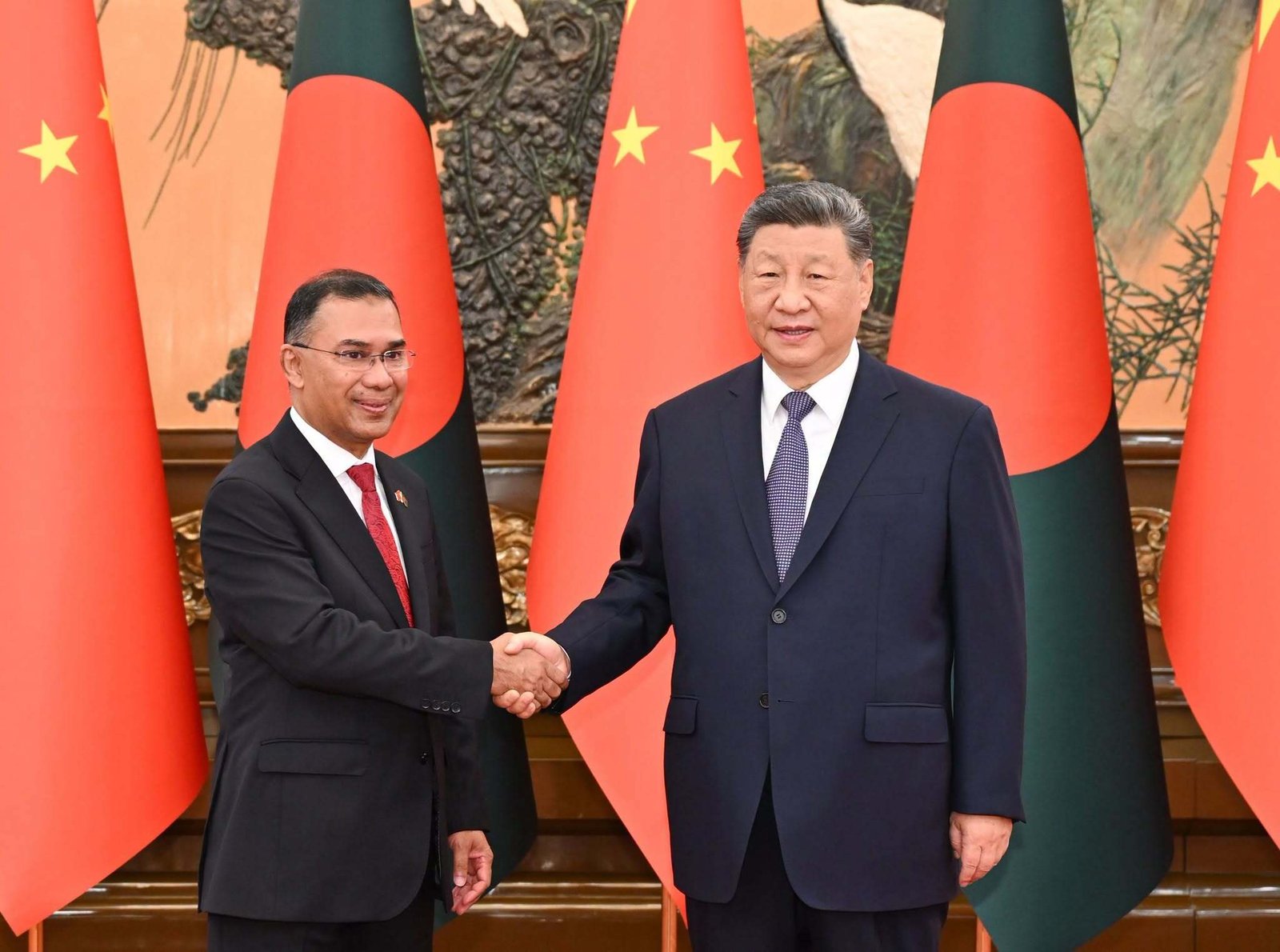
When news broke that Bangladesh was moving on a $2.2 billion deal for 20 Chinese J-10C fighter jets, it wasn’t seen completely positively. And that’s understandable. One half saw a long-overdue upgrade for an air force still flying retired-in-all-but-name F-7s. The other half saw Hambantota, and asked the question that now attaches itself to every Chinese cheque in South Asia: are we being trapped?
The honest answer, once you go through the numbers, is no. But the more interesting answer is that the debt-trap question is the wrong one to be asking.
Three ways to measure how much China holds over Dhaka
The debt-trap argument only looks at one of them. Switch between the three and the picture changes completely.
one met in part · tap any line for the evidence
- Chinese debt passes 15% of the total
- A PLA Navy port call at Chattogram or Mongla
- An RMB–taka swap line opens
- Teesta goes to a Chinese contractor
- The IMF programme stalls
- Arms imports stay above 70% Chinese past 2028
China’s interest in Bangladesh can be suspicious
Bangladesh’s government owes roughly $77 billion abroad. China’s share of that is about $5.4 to $5.9 billion, or somewhere between 8 and 9 percent. That puts Beijing fourth on the creditor list, behind the World Bank at around $20.6 billion, the Asian Development Bank at $15.7 billion, and Japan at $11.3 billion.
The $7.5 billion figure that circulates in headlines is cumulative gross disbursement since 1975. It is not what Bangladesh currently owes.
So the structure of Bangladesh’s debt is almost the textbook opposite of a debt-trap profile. It is overwhelmingly multilateral, overwhelmingly concessional, and spread across creditors who have every institutional reason to keep the country solvent. The IMF and World Bank rate Bangladesh at moderate risk of debt distress, and the downgrade from “low” in 2024 was driven by a revision to export figures, not by anything Beijing did.
But Chinese loans cost more. They carry 2 to 3 percent interest, often floating against SOFR, plus commitment and management fees, on roughly 20-year maturities. Japanese ODA runs closer to 0.1 to 1 percent. So China’s share of what Bangladesh actually pays each year is far larger than its 9 percent share of the stock. AidData tracked interest payments to China rising from about $82 million in 2018 to roughly $475 million in 2024. The Payra coal plant loan, around $2 billion through China Eximbank, is the sore tooth in the portfolio.
In January and March 2025, Bangladesh requested a cut to 1 percent interest, a waiver on fees, and an extension from 20 to 30 years. China agreed in principle to the extension on about $3.5 billion worth of loans.
But it isn’t the debt trap theory we should be thinking about
The term ‘debt trap diplomacy’ comes from Indian analyst Brahma Chellaney in 2017, and it rests almost entirely on one case: Hambantota port in Sri Lanka.
Lee Jones and Shahar Hameiri’s Chatham House study found the projects were initiated by recipient governments pursuing domestic agendas, and that the debt problems came from local elite misconduct and Western-dominated bond markets. Deborah Brautigam’s work at Johns Hopkins reached similar conclusions. Chinese loans were around 9 percent of Sri Lanka’s government debt. There was no seizure and no debt-for-equity swap; a Chinese state firm signed a 99-year lease worth $1.1 billion, and Chinese naval vessels cannot use the port. Sri Lanka’s 2022 default was driven by international sovereign bondholders.
The thing that actually Bangladesh should be looking at
Here is where Bangladesh should be paying attention.
Trade. Bangladesh imported about $20.6 billion from China in FY2024-25 and exported $740 million back. That is a deficit near $20 billion. Zero-tariff access to the Chinese market hasn’t dented it, because Bangladesh doesn’t make enough things China wants. Meanwhile the garment sector, 80 percent of exports and four million jobs, runs on Chinese cotton, machinery and intermediate goods. Cut that supply and the economy stops. No loan agreement gives Beijing anything close to that kind of grip.
Defence. SIPRI put China at 74 percent of Bangladeshi arms imports for 2018–22. Ming-class submarines, Type 053H and 056 hulls, MBT-2000s, F-7s, K-8 trainers, HQ-7 batteries, C-802 missiles. Spares, munitions and maintenance all run through one capital. The J-10 deal extends that for another thirty years.
Notably, though, the jet deal is structured as phased budget instalments running to roughly FY2035-36, not as a disclosed Chinese loan. It deepens defence dependence without adding meaningfully to debt.
The strategic logic, from Beijing’s side
A bankrupt Bangladesh cannot buy fighter jets, absorb $20 billion in imports, or host relocated Chinese factories fleeing American tariffs. Insolvency would destroy exactly the leverage China values. Beijing does not need a debt trap here, because flow-based dependence is cheaper, quieter and reputationally free.
And Bangladesh, from Beijing’s chair, is an unusually good defence partner. India is a strategic rival with a live border dispute. The United States is India’s partner in the Quad. Bangladesh sits at the top of the Bay of Bengal, needs to modernise badly, cannot easily buy American because of ITAR and CAATSA friction, and cannot easily afford European. China sells capable kit, on credit terms nobody else offers, with no lectures attached. That is a genuine fit, not a con.
Bangladesh isn’t helpless
The Sonadia case should end the argument that Dhaka is a passenger. Bangladesh shelved the China-favoured deep-sea port and went with Japanese-built Matarbari instead. It self-financed the Padma Bridge after the World Bank walked. Rooppur is Russian. It is now buying Turkish air defence, a French radar, and a British naval vessel.
So it’s not a debt trap, but yes, it is still a dependency that Bangladesh has the room to price and manage. Whether it does is a domestic question of how smartly Bangladesh can navigate this global powerplay.
Sources & further reading
16 references · all links live at time of writing- International Monetary Fund — www.elibrary.imf.org
- The Diplomat — thediplomat.com
- Pacific Forum — pacforum.org
- Friends of Socialist China — socialistchina.org
- The Jamestown Foundation — jamestown.org
- The Business Standard — www.tbsnews.net
- The Daily Star — www.thedailystar.net
- International Trade Council — tradecouncil.org
- The Financial Express (Bangladesh) — thefinancialexpress.com.bd
- Netra News — netra.news
- 9DASHLINE — www.9dashline.com
- Benar News — www.benarnews.org
- Deccan Herald — www.deccanherald.com
- ThePrint — theprint.in
- The Tribune (India) — www.tribuneindia.com
- Hofstra Journal of International Business & Law — www.hofstrajibl.org

Leave a Reply